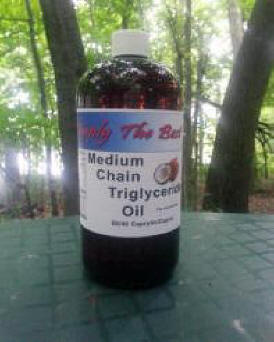
MCT Oils (Medium Chain
Triglycerides) In our discussion on
Coconut Oil, we
touched on Medium Chain Triglycerides. These are the oils that make
Coconut Oil the “low-fat fat.” If you’re a regular of WebMD, you’ll be shocked
to find that coconut oil is bad for you. The American Heart
Association wants us to limit our saturated fats. Why? Because
doctors and dieticians don’t know squat about nutrition. They think
saturated fats are bad for us. This is ridiculous. They do say, at WebMD, that the saturated fats in
coconut oil aren’t as bad as most saturated fats because they are
made up of medium chain triglycerides. However, for centuries, lard was very good for
human beings. Only recently has lard become toxic. Toxins are stored
in our fat. The environment is toxic. Thus lard has become toxic. Modern medicine seems to think that fats are
fats, that all fats are the same. Nothing could be further from the
truth. As consumers, we must be careful of the types of fats we use,
and the toxicity of those fats. Medium Chain Triglycerides, as we said above,
come from coconut oil, and sometimes palm oil. These fats are metabolized very differently from
most fats, and they seem to have some very healing qualities, but
there is a caveat. When we eat, our blood sugar increases
stimulating insulin production. Insulin is a “fat storing” hormone.
The carbs we eat are metabolized in our liver and burned off for
instant energy, while the fats we’ve eaten get stored away as energy
stores we can use later. Fats create much more energy than carbs and
starches (and sugars). MCT fats are different from other fats. They too
are metabolized in your liver and burned quickly like your carbs.
The fact is, MCT oils do not store well in our fat cells. They burn
quickly and they “help” us burn our other fats (like priming a
pump). If you take them a half hour prior to eating, they curb your
appetite. So, one strategy in dieting is to make up a salad early
and uses MCT oils in your salad dressing. And of course I’m going to
go over all our recipes and add a little note on MCT oil. An
Important Note for Those of You Who Google The Internet is full of misinformation and
confusing information about MCT oils. There are a few sites I visit
regularly to supplement my research, and it was on this subject that
I found the most confusion. Most of the info on MCTs come from research on
Coconut Oil. But MCT Oil is NOT Coconut Oil; MCT Oil has been
extracted from Coconut Oil and/or Palm Oil. One doctor’s site I trust more than Mercola’s was
really way off base praising MCTs for their anti-viral, anti-biotic
properties. Lauric Acid (a fatty acid) is an MCT oil that has all
these properties, but (and here is the caveat) if you buy “MCT Oil,”
you will not get more than 1% Lauric Acid; you’ll get Caprylic and
Capric fatty acids. The smoking temperature of Coconut Oil is 350
degrees. Some of you know I’m a “low temp” chef. Nothing in my
kitchen is ever cooked over 350 degrees. However, the smoking
temperature of MCT oil is … unknown. I say this because I’ve found
six different temperatures. I’m going to assume that it’s lower than
Coconut Oil and if you cook with it, you need to keep the temp low.
Once these oils “burn,” they become toxic. Personally if I wanted to
cook at a temp over 350, I’d use Macadamia Nut Oil. In MCT oils available commercially, the two oils
most often used are Caprylic and Capric in a 60/40 ratio. These oils
are mostly known for the following properties:
Again, if you search the web, you’ll find more properties of MCT oils, but most of the time those are actually properties of Coconut Oil. MCTs are stable and have a two year shelf life. Back To
Our Subject We know that
coconut oil is
anti-viral and anti-bacterial, and that is mostly due to the
lauric acid content. The MCT oils are also anti-pathogenic, but only
slightly and not as much as the lauric acid. This is also important to dieters and people with metabolic syndrome (or borderline metabolic syndrome), because maintaining a healthy balance of “gut microbiota” helps maintain weight and keeps inflammation down. Additionally, MCT Oil increases and maintains insulin (and leptin) sensitivity. To summarize: MCT oils are anti-inflammatory, assist in regulating hormones, keep blood sugar from spiking, and support a healthy immune system. Just BE CAREFUL when you start using them. Because they give an energy boost, many people put a teaspoon in their morning coffee.
These oils are tasteless and odorless. But if you use too much right away, because they are “easily digested,” you’ll get good news and bad news. The good news is you’re going to have lots of extra energy. The bad news is you’ll be using that energy to run to the toilette. Now let’s
get something straight. MCT oil is NOT better than Coconut Oil. Coconut oil does everything MCT oil does and better, again because of the lauric acid content, with the one exception that the more you use eventually you’ll put fat on your hips, thighs, and belly. MCT oils will always burn off as soon as they can, giving you extra energy. Additionally, Coconut Oil is natural (if cold pressed and virgin), whereas MCT oil is man-made from coconut oil. We were going to link you (through one of our affiliate programs) to NOW Foods MCT Oils, but I contacted NOW Foods and learned that they are made from Palm Oil (and Coconut Oil), and most Palm Oil is not collected sustainably, damaging the habitat of many animals. So, I helped Simply the Best get a form that was made from cold pressed Coconut Oil only, from the same supplier of Macadamia Nut Oil. Weight
Conscious? If you are dieting or weight conscious or suffering from metabolic syndrome, MCT Oil in your regimen is better for you “overall” than Coconut Oil. Again, too much Coconut Oil will put weight on you and it’s very hard to make salad dressings or mayo from Coconut Oil because it is a solid at room temp or in the fridge. In other words, MCT Oils are superior to Coconut Oil only in that they’re easier to administer (like in coffee), easier to make salad dressing and mayo with, and they give you quick energy without hanging around on your hips, plus those other properties listed above. And since we’re assuming their smoke temperature is lower than Coconut Oil, again, you might not want to cook with them. Now get this. MCT Oil is naturally made by your skin. These natural oils are antibacterial. As we age, of course, their production slows and most people wash their faces an awful lot, washing away these oils. This is why Coconut Oil is so good for our skin. It puts back the anti-microbial oils we keep washing away. MCT Oil is also good for our skin, but again, the anti-microbial effect will not be as great as it would be with Coconut Oil, but this stuff is also great for your hair, and they go on easier than Coconut Oil. MCT Oil has a long shelf life, and oils with a long shelf life are very good for the skin. It’s mild, and so far, I’ve not come across anyone with any type of skin that is too sensitive to it. They appear in a lot of skin products, and if you use it by itself, you’ll find that just a little bit goes a long way. And I helped them get this stuff in, so Simply the Best has the best price for the best oil on the web: MCT Oil @ Simply the Best.
Click here to email this page to a friend.
Articles
|
Newsletter
|
Who We Are | Links
|
Search Site ©
Copyright 2016 Minnesota
Wellness Publications, Inc.
David's PhotoArt - Fine Art Supporting The International
Wellness Directory |