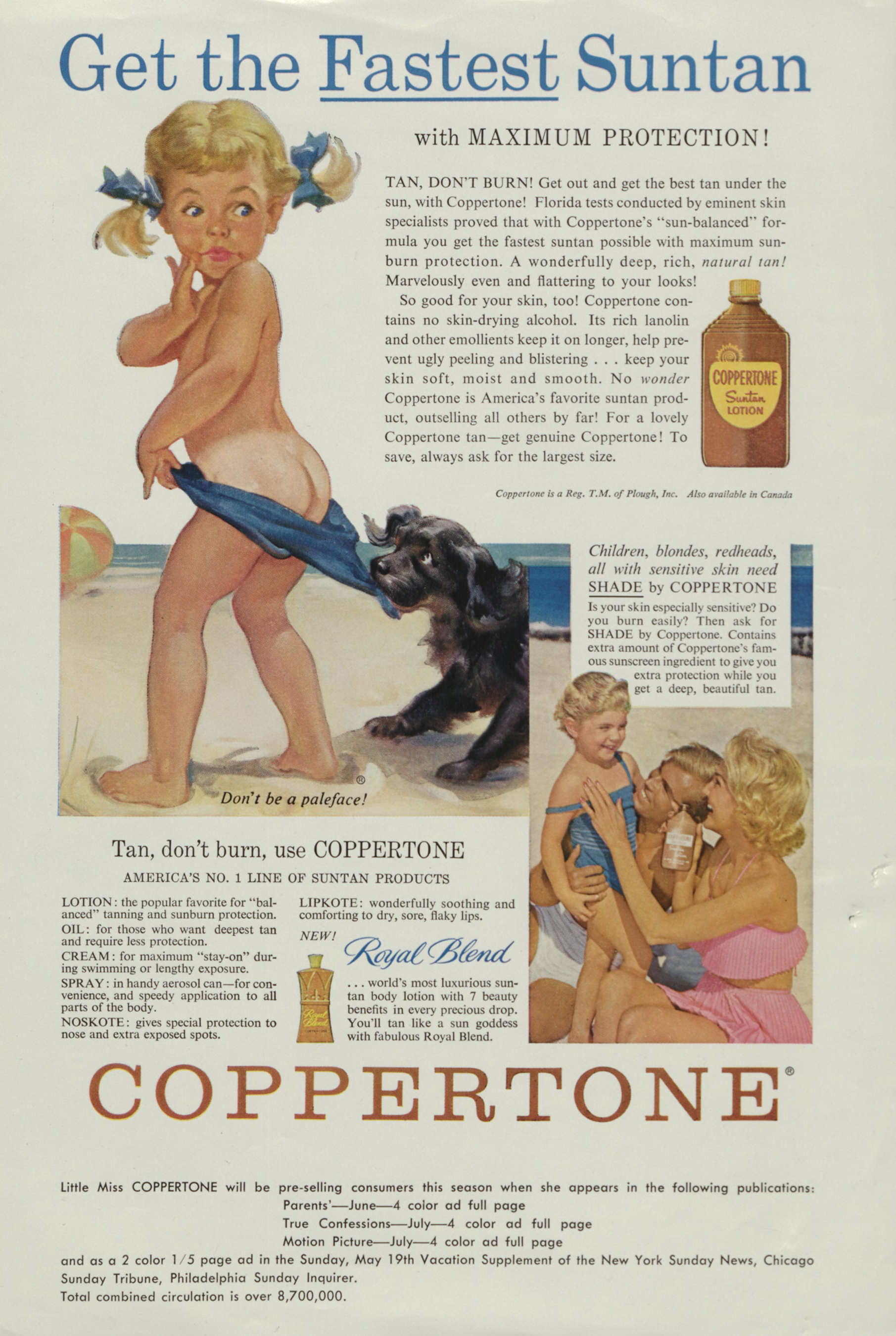
Homemade Sunscreen When I was a kid, sunscreens were called “suntan lotions.” I’m sure everyone my age remembers the Coppertone girl. She was in magazines, on billboards, and on TV. Just click on the images to see the larger version. This first ad is from the fifties. There is no mention of sunscreen. The second one is late sixties or early seventies. The term sunscreen is in there, but I personally don’t remember hearing that term until the mid-eighties. One of the first things I heard about sunscreens was that they were toxic and probably not protecting anyone from cancer, and in fact, they were, most likely, contributing to the cause of cancer. The Environmental Working Group lists the worst of the worst here: Sunscreen Hall of Shame. One thing the article points out is so many sunscreens list an SPF of 60 and 70 when this is pure BS. Your sunscreen tops out somewhere between 30 and 50. And the chemicals in them are toxic, but don’t expect the FDA to move on them soon. This is the “free market” at work. Survival of the fittest. However, before you put ON a sunscreen, you might want to consider putting a sunscreen IN your body. Sun Protection from the Inside Out Fish and some reptiles have a natural antioxidant inside that protect them from the sun called gadusol. Gadusol is similar in many ways to vitamin C or ascorbic acid. Did you know that spraying your body with ascorbic acid will protect you from the sun? The problem is, research won’t soon find out if it works for humans, but you can read about it here: Natural sunscreen that works from the inside out?Few realize that our nutrition can protect us, to a degree, from the sun. For example, Italians burn less than the rest of Europeans, but not necessarily because of their darker skin. They consume more cooked tomatoes than the rest of Europe. Tomatoes contain lycopene. When cooked and mixed with oils (lycopene is an oil soluble nutrient), lycopene uptake is increased. In 2011 a study concluded: Tomato paste containing lycopene provides protection against acute and potentially longer-term aspects of photodamage.Additionally, vitamin D (something that is discussed all over our web site and it seems like everyday we learn something new about this wonderful nutrient) protects against mutagenic [causing mutations] ultraviolet radiation. I take 5,000 IU of NOW Foods Vitamin D3 daily (almost daily…I forget at times). I just had my vitamin D levels tested and they were perfect.Something else we’ve discussed at length are OPCs (such as pycnogenol) which are also referred to as proanthocyanidins. These are antioxidants and bioflavonoids that support many functions, but most important they strengthen our capillary system. These, according to a 2011 study, protect us from the damages of UV light. Related to OPCs is resveratrol, which, in a 2005 study, protected mice from UV radiation.One of the best newsletters I've ever gotten is from Dr Alan Sears. His books, programs, and products are just the best. He actually sells a sunscreen that works from the inside out. You can read about it here: Sunscreen From The Inside Out. Good Fats We know how good omega-3s are for us, and you’d be right to guess that they protect us from mutagenic damage due to UV radiation, but did you know that saturated fats also protect us? It was Johanna Budwig who originally told us that trans fats lead to skin cancers and recommended omega-3s to reverse that damage, but in 1984 a study showed that people whose diets with sufficient saturated fats actually fights the development of melanoma. Thus butter and coconut oil in your diet will help protect you from UV damage.Budwig’s research was re-affirmed in Australia in a 2011 study that showed the skin protective properties of omega-3s. Just a year earlier another study showed that Astaxanthin, the orange (carotenoids) pigment we get from certain fish oils, is especially protective against UV light and against skin aging and wrinkles.Finally you have green tea, vitamin C, and alpha lipoic acid. These have all been found to prevent skin damage, on the inside, and also on the outside. One of the first alternative sun screens I ever made was a bit of ascorbic acid in water, sprayed onto my body. It worked well, but if I went swimming, I had to re-apply. You should note that buffered ascorbic acid does not give the same protection. Later when I learned about the skin protection of green tea, I would mix my vitamin c (ascorbic acid) in green tea. It worked quite well, but keep in mind that I’m also pretty much consuming the rest of the nutrition listed above. Please Note: These nutritional sunscreens protect you from the damaging effects of the sun. They don't stop you from tanning and they don't stop you from being really stupid and getting burnt to a crisp. We need the sun, but even when protected, we still need it in moderation. Homemade Sunscreen/Suntan Lotions Once again, sunscreen used to be suntan lotions. They did not cut out all UV rays; their SPFs were low, around 6, to 10, sometimes maybe 12. It’s hard to tell because they are no longer made.
As a teen, I used to use olive oil on my skin and lemon juice in my hair and pretend I could surf. However, my life as a beach bum was interrupted by the war in Vietnam. How SPF Works Let us hypothetically say that if you sat in the sun with nothing on your skin, you would burn in half an hour. An SPF 2 on you would double that time: 1 hour. An SPF of 10 would allow you to burn ten times later, or 10 X 30, after 300 minutes, or five hours. First, let us make a base. Your base depends on whether you want it to stay on if you go for a swim. Most oils will stay on when you go swimming, to a degree, but to make sure they stay on, you need a base of bees wax. We’ll start with a suntan lotion for those of you who want to tan; a relatively low SPF. Macadamia nut oil. Yup, that’s it. It has an SPF of 6. If you are light/fair skinned, you’ll want to suntan less than someone with dark skin. For this, macadamia nut oil is all you need. It’s great for your skin, allows you to sit out six times longer than you would with nothing, and it smells wonderful. And now you can find it at Simply the Best: Macadamia Nut Oil. You can add essential oils to your macadamia nut oil, such as ylang ylang, or jasmine. If, however, you want a very powerful sunscreen, then we’re going to have to make up something with a high SPF and oils that are great for your skin. The Base ¼ Cup Macadamia Nut oil (SPF 6) ¼ Cup Coconut oil (SPF 4 – 12, avg 6) ¼ Cup Beeswax (SPF 15) If all of the above are organic, you’ve got yourself a very healing lotion. The macadamia nut oil is as good for you, if not better than the expensive Argon oil, and Coconut Oil contains antioxidants and anti-inflammatories. Organic beeswax also fights free radicals. Together, this is one heck of a combination. Simple Directions Mix up as much as you want in a quart jar with that above ratio (1:1:1), boil up some water on the stove, and place this in the middle. As the coconut oil and beeswax start to melt, start stirring to mix everything together. Now, if you want even more protection, find some non-nanno zinc oxide powder on Amazon. Two tablespoons is all you need in the above recipe (double it if you double the recipe) to make a 15 – 20 SPF sun screen. (We have an option below that you might want to use instead of the zinc oxide.)Be careful not to breathe in the zinc oxide powder, and stir well to mix it evenly and thoroughly. Two more oils you can add that have super high SPFs are Red Raspberry Seed Oil (min SPF 25) and Carrot Seed Oil (min SPF 35). Depending on how long you want to be out and how quickly you and your family burn will determine how much of these oils you add. Usually most people add just a teaspoon, but you can add a quarter cup. This way you won’t need the zinc oxide powder. Finally, vitamin E oil is always good to add; our skin loves vitamin E. Now get this, the Red Raspberry Seed Oil above? It's got Vitamin E in it. And the Carrot Seed Oil has Vitamin A. However, Wheat Germ Oil is your best source for Vitamin E and this has an SPF rating of 20. And should you burn, you'll want to have on hand one of Ron Salley's amazing creams: Island Sunburn Crème. Testimonials abound on this, saying the pain was gone in minutes and they did not peel. But like most things, you have to have it on hand when you need it.
|


|
Click here to email this page to a friend.
Articles
|
Newsletter
|
Who We Are | Links
|
Search Site ©
Copyright 2015 Minnesota
Wellness Publications, Inc.
David's PhotoArt - Fine Art Supporting The International
Wellness Directory |