The History of the American Cancer Society Part I ─ The Early Years Editor’s note: I am a disabled Vet. One of my disabilities is a slight memory disorder. I found an interesting article on the web to show our newsletter readers and wanted to link to a related article; this one, in fact. However, upon searching the site, I discovered that I’d never written this article. I had intended to write this article. I thought I’d written this article. Just never got around to it, I guess. I should tell you that the article that I had intended to write (but didn’t) would have been a very different article than what you’re getting. This is because the internet has grown since I started the original research using just three books, three sources that I truly enjoyed reading back in the late nineties when the Internet was still young: 1. The Drug Story by Morris Bealle Morris Bealle is a top notch investigative reporter; Mullins is a conspiracy theorist (I like this type of person because their research is usually very thorough and I don’t have to go along with their conclusions), and as you can guess from his occupation, Dr Josephson was, like Dr Robert S. Mendelsohn, a medical heretic. Having spent significant time on the internet, I’ve discovered that not only has Mullins’s book has been quoted by hundreds of sites, some have even lifted entire chapters right out and reprinted them. Most interesting is that I have found “conflicting” accounts. There were none when all I had were those three sources. Now, instead of presenting you regurgitated “facts” from those sources, I am compelled to make a few judgment calls. I will present both sides, but I have to make the call here and if any reader thinks I’ve erred in my judgment, feel free to write: info@mnwelldir.org The American Cancer Society began as the American Society for the Control of Cancer in 1913 [Organize to Fight Cancer, New York Times, June 10, 1913]. Since then it has become the “golden calf” of charities and its efforts to research and disseminate causes, and supply funding to find a cure have gone astray. Today it would seem its job is to rake in a lot of dough, protecting its supporters, and as many a critic has asked, why would they ever want to end this burgeoning money maker? Why kill the goose that lays the golden eggs? It all began when Dr Clement Cleveland, a distant
relative of President Grover Cleveland, called a meeting to order in
April of 1913. Attending were women of wealth and a handful of
renowned physicians. [Rich
Women Begin a War on Cancer. New York Times, Apr. 13, 1913.]
The very next month a small group of doctors (delegates from medical societies associated with the Congress of
Physicians and Surgeons) and lay people met at the Harvard Club
in New York City. [To
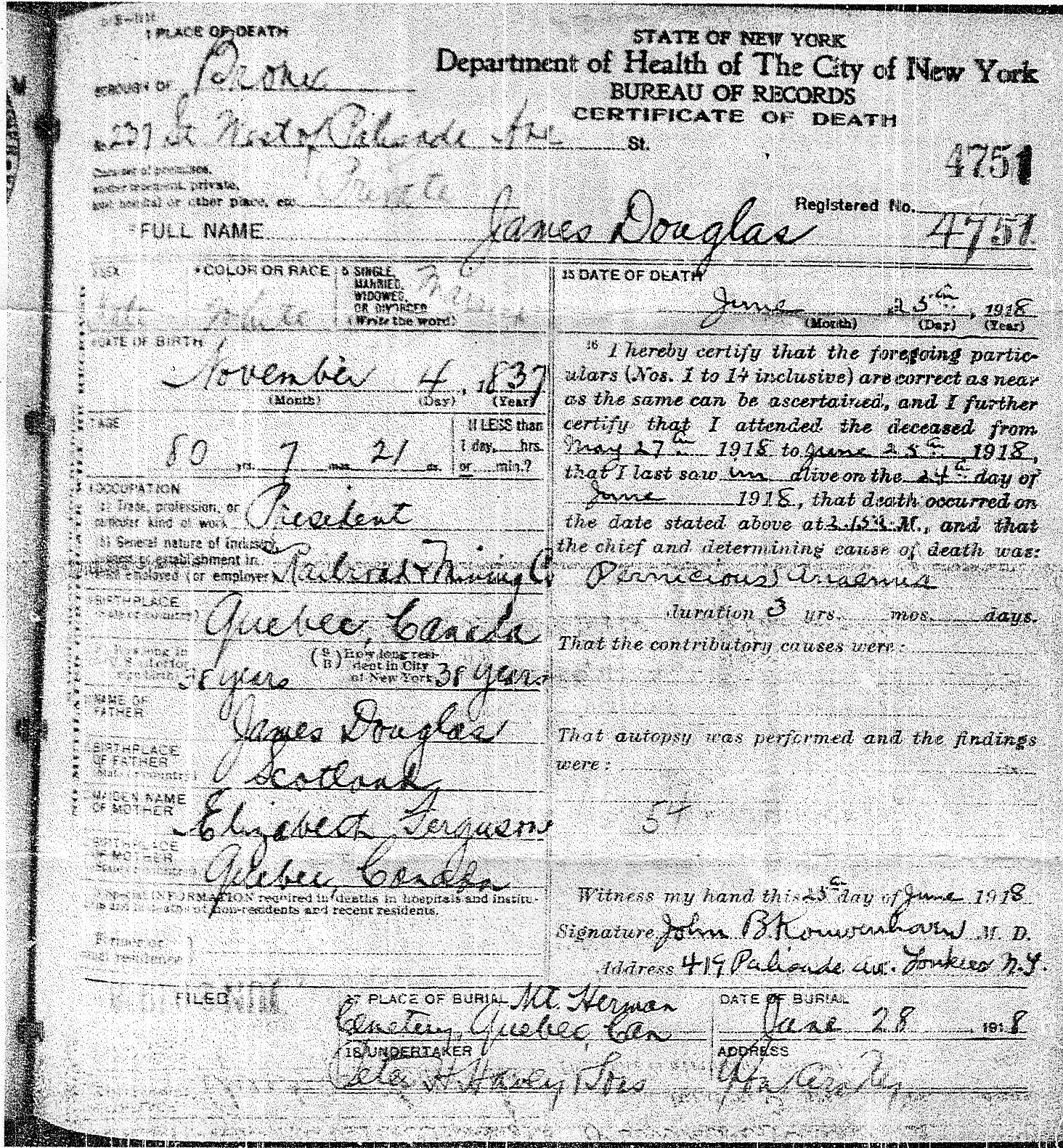
Extend Fight On Cancer, New York Times, May 23, 1913.] Initial funding of The National Anticancer Association (its temporary name up until June of 1913), was close at hand considering the names of those involved. For instance, take the name of John E Parsons, one of the founding members of the Executive Committee. If you search the web for John Edwards Parsons (photo), you’ll learn he was a distinguished lawyer who began his career as the New York County Assistant District Attorney, was a founding member of the New York City Bar Association, and played a huge role in the prosecution of some of New York’s most corrupt judges. You’ll also learn that he successfully defended his client, the American Sugar Refining Company in an anti-trust suit, which netted him a huge chunk of change having saved his client from a loss upwards of $90 million dollars. What you won’t find in Wikipedia is that he was the first president of the cancer hospital that would eventually become the Memorial Sloan-Kettering Cancer Center [1884–1915, Past Presidents]. The hospital was initially built on land donated by the Rockefellers. Parson’s son, Herbert followed in his father’s footsteps as head of the hospital, and as an attorney he was a director of the Enterprise Development Corporation, an investment trust of heirs of William Rockefeller. The Rockefellers were deeply involved in the medical monopoly, with John D Rockefeller Jr, providing much of the ASCC's initial funding. Two of Rockefellers' attorneys (one by the name of Herbert Parsons) stayed in the administration throughout the 1920s. J P Morgan too helped with funding. Dr Josephson tells us: The Society states in its publications that it cooperates with those paragons of altruism and virtue — The American Medical Association, the American College of Surgeons, the American Public Health Association, and the national radiological societies. However, Josephson warns us: Associations were formed to “control cancer.” They have been more successful in controlling the cancer business. If they incidentally increased the returns on their doctors’ investments in radium, that was hardly unexpected or undesired. He goes on to point out that the funds they’ve gathered have not been used for the “relief of cancer victims or for the payment of institutions for their care.” The design of this new “charity” was based upon the same design of the American Medical Association, with a board of trustees (later a House of Delegates in the 1950s), and a Committee on Quackery. In the fifties, the word quackery would be dropped when the committee was renamed to the Committee on Unproven Methods of Cancer Management. Josephson points out: These “authorities” systematically deny everything that does not emanate from themselves and add to their incomes [“they boost radium and surgery as the only ‘cures’ for cancer”]. They always allege the amusing reason, that the material to which they object would be used for exploitation of the public. They wish to reserve that lucrative privilege for themselves. In contrast to Dr Josephson’s vituperation, I should point out that many people in the beginning were truly idealistic. They truly wanted to cure cancer and alleviate suffering. You’ll meet Dr Ewing soon and his benefactor Dr James Douglas (not a medical doctor). Many have entered medicine with the highest ideals; not all get corrupted by the system. But then, in October of 1937, the society boasted in its Bulletin: The society is effectively passing through a period of transferred emphasis of its major activity and is well on the road to assuming a position of national influence similar to that of the National Tuberculosis Association [the largest disease association of its time]. In other words, the early idealism having faded, they had become the official cancer agency of the medical monopoly which would be their focus for years to come. For the ASCC, the years spanning from 1913 to 1944 were their growth years in which they felt their way about. It wasn’t until 1945, after changing its name to the American Cancer Society, that it began really to grow and surpass all others, becoming one of the wealthiest charities in the world, which together with Sloan Kettering Memorial Hospital, the National Cancer Institute, and the American Medical Association formed our modern medical monopoly. After co-opting the FTC and FDA as their enforcement arm they’ve become the most powerful monopoly and lobby in the world, even to this day. Personally, I find their early years extraordinarily interesting since this was when they established their roots and their methods which would evolve and define their true objectives. Ostensibly their original goal was “to disseminate knowledge concerning the symptoms, treatment and prevention of cancer, to investigate conditions under which cancer is found, and to compile statistics in regard thereto. . . .” What they’ve become, well, that is the purpose of this paper. First, however, we must try to grasp the state of the art of medicine at that time in dealing with cancer, before anything this nascent society planned or accomplished can be detailed or even understood. In 1913, the odds of a patient living through a long cancer surgery approached 30%. Even today, doctors tell us that when you “go inside” there is always the odd chance that something will go wrong. But in 1913, your odds of survival for a “long” surgery were less than 1 in 3. Additionally, there were no tests for finding cancer, at least tests that were very accurate. Cancer cells, though recognizable under a microscope at the time, still didn’t exhibit enough evidence for one to be completely sure of a proper diagnosis. As far as treatment went, there were experimental drugs but no such thing as “cancer chemotherapy” (it wouldn’t be until sometime after World War I when it was discovered, by accident, that mustard gas appeared to kill off tumors; thus the first chemotherapy agent for cancer was derived from mustard gas), and there was surgery. Because of all the noise made by the Curies (“Radium was useful — magnificently useful.”), that they’d discovered a possible cancer cure (because it could eat flesh), radium therapy was introduced in Paris in 1898, and was soon after called "telecurie therapy." Memorial Hospital in New York City began using x-rays in 1902 and using radium in 1903. Interest in radium would grow making it the latest and greatest cancer “cure” that would sweep the world in the twenties, only to be discarded years later. During 1913–1916 surgeons Howard Kelly (Baltimore) and H. H. Janeway (Memorial Hospital) began using radium and radon for the treatment of deep seated cancers. Their technique required placement of the sources several centimeters away from the skin surface. As this new concept, telecurie therapy, resulted in a significant decrease in dose rate, it was necessary for both surgeons to have several grams of radium, costing $180,000/gram, in their possession. Fortunately, Kelly and Janeway were the sole beneficiaries of a radium mining company, the National Radium Institute, from 1913 to 1916. With this unique American source of radium and with Europe otherwise preoccupied, these two American surgeons pioneered megavoltage telecurie therapy, using the 1.2 MeV gamma rays of “mass radium.” © 2000 American Association of Physicists in Medicine.[http://www.ncbi.nlm.nih.gov/pubmed/10902549] Telecurie therapy was named after Madame Curie; the tele meaning from a distance. Radium packs (also called, cannons or bombs) were placed a distance from the cancer. Later the term was dropped as doctors split open tumors and inserted the radium packs inside. We do not have any figures on rates of cure, but as many have pointed out over and over, they were quite dismal. To most people cancer was a death sentence. However, if the cancer was reachable by surgery and still in stage one (not yet invading lymph nodes) survival was possible: In 1922, Geoffrey Keynes, an English surgeon (the brother of economist John Maynard Keynes), began using local excision and radiation therapy to treat breast cancer. He treated many patients with stage 1 breast cancer (there was no evidence of tumor cells in the lymph nodes). Over 70 percent of his patients survived five years, a respectable figure for the times. As the sole practitioner of local excision and radiation, he was criticized, and his results were unfairly compared to the best results of his colleagues. Eventually he reverted to total removal of the breast, because 8 percent of his patients developed local recurrence. But this rate of recurrence was actually no higher than that following radical surgery, and even today would be considered good results. [http://www.texascancercenter.com/cancerhistory.html] On the darker side of radium, by 1922, according to Mullins [Murder By Injection] over a hundred radiologists had died from radiation poisoning. Dead too was the woman who discovered radium, Madame Currie and her daughter. Many more who died without much notice were the miners who dug up the ores that would become radium. Finally, there were the “radium girls”; those young ladies who painted the hands and numbers on watches so they would glow in the dark. To keep the tips of their paint brushes pointed, they’d lick the tips. Many died. The full story can be found here: Radium Girls.Today we look back flabbergasted that pioneers in radium were so overjoyed in their initial findings that radium would cause burns and blisters. Who’da thunk that from these observations patent medicine hucksters would invent the cure-all tonic: Radium Water? One of the earliest entrepreneurs in radium was a mining mogul by the name of James Douglas. Born in Canada, he owned the largest copper mine in the world. According to Mullins, Dr James Douglas (a doctor of divinity) would self treat using radium until his death, which Mullins claims was radium related (aplastic anemia). However, we are in possession of a copy of James Douglas' death certificate, and below you will see that Mullins got another one wrong. Douglas began his adult life studying to be a
Presbyterian minister, but was never
He was one of the youngest presidents of that society and gave numerous lectures to its members, on Egyptian hieroglyphics and mummies, and later on geological subjects, and finally mining. It was mining that drew him away from medicine, and working with a Dr Thomas Sterry Hunt, patented the Hunt and Douglas process for extracting copper from copper ore. With no formal training in chemistry, he was chosen to fill the Chair of Chemistry at his hometown college from 1871 to 1874. His evening lectures, we are told, were among the most popular at that college. Douglas’s interest in medicine returned when his daughter died of cancer. Having followed closely in his philanthropic father’s footsteps, the death of his daughter was a powerful influence on where he put his money. It was about this same time that radium was discovered in his copper mines in Arizona. There seems to be two views of Dr James Douglas proffered by historians. They both see him as an intensely passionate and brilliant person, but where they differ is in his motives behind his philanthropy. One side feels he was altruistic, while the other side claims he gave so that he could reap still greater profits. His philanthropy began by supporting one of his father’s causes, the Douglas Hospital in Montreal, originally called the Protestant Hospital for the Insane. It was renamed the Douglas Hospital after Dr James Douglas in 1965 as a tribute to both him and his father. Though historians most often remember his donations to the Memorial Hospital of New York, I’ve found a few inaccurate mentions of a donation of nearly a million dollars in radium to Johns Hopkins University in 1913. Douglas never donated to Johns Hopkins, but his partner, Dr Kelly, did. Douglas will eventually give away a total of 3.75 grams away later to Memorial Hospital, which was half of what he and Kelly had mined in three plus years between 1913 and 1917. I feel it incumbent upon myself to thoroughly lay out Douglas’s history here so that we may know the man for who he is rather than the person painted by historians with an agenda. But first I want you to meet Dr James S Ewing. Ewing dedicated his life to studying cancer. By 1910 he had published some 50 papers from his work in his laboratory, concluding that the best hope for controlling cancer was to study the disease in man. He proposed to the New York Hospital to establish a commission to study human cancer, but was turned down. It was then that he met Dr James Douglas who was looking to support cancer research. Together they approached the Memorial Hospital. Memorial Hospital was founded in 1884 as the New York Cancer Hospital. It soon became known as simply Memorial Hospital, that is, until approached by James Douglas offering a $100,000.00 donation (nearly $2.5 million by today’s standards). Historians point out that the offer came with a few conditions. From the book, Reclaiming Our Health, page 231, by John Robbins: Memorial Sloan-Kettering (now the world’s largest private cancer treatment and research center) was already committed to the use of radiation in cancer treatment. The cancer center had accepted tremendous donations from an immensely wealthy businessman named James Douglas in 1913. But, according to Memorial Sloan-Kettering’s former official historian, Bob Considine, “Douglas’s enormous gifts came with strings attached.” Douglas owned vast numbers of radium mines, and stood to profit enormously if the medical use of radiation caught on. He had insisted, as a basic condition of his contributions, that the center routinely use radiation in all of its cancer treatments. From the Society of Surgical Oncology’s web site we get: The financial support provided for Memorial Hospital in 1912 by Douglas carried two provisions: (1) that Memorial once again engage exclusively in the diagnosis, treatment, and study of cancer; and (2) that Dr. Ewing be appointed Pathologist of the Hospital. Mullins has three conditions in his book: Douglas offered to give Memorial Hospital $100,000, but there were several conditions. One was that the hospital must hire Dr Ewing as its chief pathologist; the second was that the hospital must commit itself to treating nothing but cancer, and that it would routinely use radium in its cancer treatments. If there were more conditions, we do not know of them, but all three of these conditions seem to have been accepted as the hospital was renamed in 1916 to: General Memorial Hospital for the Treatment of Cancer and Allied Diseases, Ewing was installed as the chief pathologist, and the use of radium therapy at the hospital began a slow but steady climb. One thing we must take into consideration when Douglas made these conditions was that the amount of pure radium in the world at that time was small, though not very much was needed for any purpose. Some huckster could take a milligram of radium and make a million barrels of “radium water.” Radium water, by the way, was just one of the products accepted by the AMA Council on Pharmacy and Chemistry in 1914. Dr Josephson in his book, Your Life is Their Toy, points out that this new cancer “cure” boosted radium’s value. He claims that the price rose 1000% in just four years, though he does not tell us which four years. We can assume they were prior to 1913 because he also tells us that at that time radium sold at almost ten million dollars a pound. We know this was prior to 1913 because, in a paper presented by Dr. Bertrand Goldschmidt at the Fourteenth International Symposium held by the Uranium Institute in London, September 1989 entitled Uranium's Scientific History 1789 - 1939 we learn that in 1913 radium sold for $160,000 per gram, which would make a pound of radium worth well over ten million dollars; a pound would cost $72,574,720.00. However, I have no clue why we're even talking about pounds since it would be years before a pound would have been mined and refined. Goldschmidt also tells us that by 1913 just 20 grams of radium had been produced in France and Austria, and World War I was just about to bring all European mining to a halt for a period of time. It was during the war that Douglas and Kelly would buy up radium claims in the US and discover a cheaper process for refining the final product. I’ve included, below, a picture of the original New York Times article published on October 24th, 1913, entitled: "Radium Cure Free to All." Mullins writes: The claim was made that "not once cents worth of
radium will be for sale," Douglas was greatly annoyed by this
statement, and on October 24, 1913, he had the Times run a
correction. He was quoted as follows, “All this story about
humanity and philanthropy is foolish. I want it understood that I
shall do what I like with the radium that belongs to me.”
Mullins continues on claiming that Memorial Hospital had been mistaken in thinking this was a donation and their rules changed so that “an extra charge would be made for Radium Emanations used in the treatment of patients.” He also writes: “In 1924, the Radium Department at Memorial Hospital gave $18,000 radium treatments to patients, for which it charged $70,000 its largest single source of income for that year.” Mullins finally writes: Meanwhile, James Douglas, who had boasted that he would do what he liked with his radium, continued to give himself frequent treatments. A few weeks after the New York Times story in 1913, he died of aplastic anemia. Those of you paying attention realize that, according to Mullins, Douglas continued to donate radium 4 years after he died. Mullins, whose work is splattered all over the web, is full of bulltwaddle. His facts are so badly off, I can only assume that his conclusions are just as far off. Yes, some doctors of the time made money investing in radium, and they’d had inside information. Mullins claims that Douglas forced the New York Times to make a retraction on the very same day they published the article I’ve posted here, October 24th, 1913. That is impossible. Newspapers cannot publish retractions the same day an article is posted, and Douglas did not die shortly after that of aplastic anemia. There is no obituary in any archives concerning his death or reason thereof. One journal published a short bio after his death, but gave no cause (See Image Below). Additionally, I have contacted a person in charge at the Times who runs the archives. I was told that if I could not find an article, that it did not exist. A search of all newspaper articles over that period brought up nothing. The retraction does not exist, except in the mind of Mullins and of his minions who have reposted his libel. Again, though Mullins claims Douglass died of aplastic anemia, we happen to know better.
According to the EPA, "Long-term exposure to radium increases
the risk of developing several diseases. Inhaled or ingested radium
increases the risk of developing such diseases as lymphoma, bone
cancer, and diseases that affect the formation of blood, such as
leukemia and aplastic anemia. These effects usually
take years to develop. External exposure to radium's gamma radiation
increases the risk of cancer to varying degrees in all tissues and
organs." [editor added the bold type]
According to his death certificate (click on the thumbnail on the right), Douglas died from "pernicious anemia." Pernicious anemia is considered to be an autoimmune disorder in which the body's immune system attacks the tissues that make intrinsic factor. Intrinsic factor is needed by vitamin B-12 for absorption. In a healthy individual, intrinsic factor (a protein made in the stomach) bonds with B-12 facilitating the absorption by the small intestines. Death is caused by a B-12 deficiency. Douglas' death has nothing to do with radium.
This is the final straw. Mullins cannot be trusted and I keep thinking about the rest of his book, whether anything he's written can be trusted. It's almost as if he made up everything about Douglas' greed and then gave him his just rewards by killing him off with his own radium. Because of the article below published the year he died [1918, not 1913], we know a few things about Douglas' donation: The general price of radium during this time was $100,000 per gram. 3.75 grams was half the total radium output for Douglas’s organization, the National Radium Institute over a three year period. It was a donation with no strings to be used in cancer therapy. Douglas died 5 years after his initial donations in 1913, at the ripe age of 80 years old.
The image above is from a book/pamphlet published in 1918 called Chemical & Metallurgical Engineering, Volume 19, edited by Eugene Franz Roeber, Howard Coon Parmelee. Click on the image above to visit Google Books to read the piece in a clearer version. We also know that Mullins’s report on the hospital charging $70,000.00 for radium treatment is pure fantasy. A $70,000.00 treatment in 1924 would cost over $929,451.00 in today's money.Nobody can pay that amount of money today for a therapy, not even an insurance company. Ok, I lied. Only the very, very rich can afford to pay that much for therapy. According to Wikipedia, Douglas' net worth was $18 million at the time of death, however the information at Wikipedia is not all that trustworthy as they also claim that Douglas donated a million dollars in radium to Johns Hopkins. His mining partner, Dr Howard A Kelly, though, was affiliated with Johns Hopkins and he supplied them from his split of the radium. Douglas and Kelly had basically created of monopoly on radium in American and some questioned their motives. In an exclusive in the New York Times, January 24, 1914, a prospector, O B Wilmarth, testified before the House Public Lands Commission that Kelly had “mercenary motives” and that, according to his testimony, “if the radium lands were withdrawn from public entry prospectors would be shut out, and this would bottle up the radium-bearing ores for the use of the plant of the national Radium Institute, which Dr Kelly and James Douglas of New York had founded.” The chairman of the commission responded that according to Kelly’s accountant, all the radium was being donated to fight cancer free of charge and that no one profited. A thorough search of newspapers from that time resulted in articles that talk only about the charitable donations of Kelly and Douglas with not a single mention of them selling their interests for profit. The one question we’ve been able to solve concerns the 3.75 grams of radium donated by Douglas to Memorial Hospital. Some sites have it being donated at one time in 1917, while, from the newspaper articles from the time it appears that the donation took place over a period of five years. We located a rare book at the Minnesota Historical Society, James Douglas, A Memoir, which confirmed (on page 117) that Douglas and Kelly had mined and refined seven and a half grams of radium between 1913 and 1917, and that Douglas and Kelly had split it evenly, with each donating their entire portion to their chosen hospitals. Having put to rest the libelous attacks on Douglas by Mullins, it’s time to bring up Dr James S Ewing again. Mullins accuses Ewing of guilt by association and working for the interests of
Douglas rather than the interests of people suffering from cancer. What did Ewing have to do with the American Society for the Control of Cancer? He was one of the doctors who met at the Harvard Club to start the society. Though there had been a number of initial meetings, it was on May 22, 1913 that the core organization, the executive committee, had been formed and officers were elected. It would not be until 1922 when they were finally incorporated. Ewing sat on the executive committee. He was an amazing doctor who, as a pathologist, relied on results to make his decisions. Though he could have been very wealthy from his practice, he lived a Spartan life and when patients came to him who could not afford medical care, he often handed them a signed blank check. The best article I’ve found about him is here: Dr James Ewing. Dr Ewing was among the first to associate tobacco with cancers of the mouth, however, he also said that overeating caused cancer. Today, we know about obesity related inflammation, so, as you can see he was onto something, although he felt that it was the abuse of the stomach that brought it on. At times he defended radium therapy while at other times he took a wait and see approach. Another doctor that one of my sources, Josephson, got wrong is Dr Francis Carter Wood. Wood had been elected vice president of the ASCC in the twenties and Josephson quotes Wood twice about the ineffectualness of radium and then adds something to the effect of: No wonder he’s no longer their vice president. Josephson’s apocryphal attributions are: “Radium is but the weapon of the charlatan and the quack,” voiced before the graduating class in medicine of Columbia University, in 1917. “As for radium in cancer work, it effects few cures, perhaps one in a thousand,” reported in an interview of the New York Tribune, October 14, 1921. Curators at Columbia University informed me that Dr Wood never addressed a graduating class and the October 14, 1921 edition of the New York Tribune quotes Dr Wood as saying no such thing. In fact, I found the following in Radium, Volumes 17 - 18, quoting from the New York World October 26, 1921: Dr Francis Carter Wood, eminent pathologist director of the Institute of Cancer Research at Columbia University, strongly disagrees with Dr John B Deaver as to the present and possible future value of radium in the treatment of cancer. Radium is a failure as a cure for cancer, according to Dr Deaver, a distinguished surgeon of Philadelphia, who took office as President of the American College of Surgeons there on Monday night. “At times when its use could have been most valuable, radium failed utterly in the treatment of cancer,” Dr Deaver told 2,000 surgeons assembled in convention from all over the United States. “I almost hesitate to express the fear I have that nothing can be looked for from radium in the future of advantage in the treatment of cancer.” Dr Deaver told of cases where radium had been used when good effects from it were most sorely needed but its benefit had been practically negligible; indeed in many cases it worked more harm than good. “Dr John B Deaver in discussing the failure of radium to cure cancer speaks as a general surgeon and not as a specialist,” said Dr Wood yesterday. “He believes, as does the medical profession in general that at the present time radium will not cure internal malignant tumors, such as those of the stomach and intestines, even though it may greatly relieve them or retard their growth. What radium will do in the future it is impossible to say; but there is no reason to believe that it will cure all kinds of cancer. Indeed some types are so very resistant to this interesting physical agent that the destruction of the cancer cells requires such large doses that the surrounding healthy tissue is more damaged than are the diseased structures. “On the other hand, it is well known that radium is extremely effective in curing the small cancers of the face, which are, fortunately much less malignant than those in other parts of the body, and it is quite justifiable, contrary to Dr Deaver's statement, to use radium on such tumors if their exact nature is known.” Deaver was a surgeon and like that person whose only tool is a hammer, every problem looks like a nail. Never ask a barber if you need a haircut and never ask a surgeon if you need surgery. Deaver was quite famous during his time, not as much for his successes as he was for the great volume of surgeries he performed. Then again, during this time, if you caught the cancer early enough, your best hope for long term survival was to remove all of it surgically. I remember a history professor, years ago, telling our class that revolutions start off very radical, very liberal, but end conservatively. He pointed to the Declaration of Independence (a very radical document) from the beginning of the revolution, and then to the Constitution (a very conservative document) written after the end of our revolution. I’m beginning to think that this overall concept can be applied to the history of the American Cancer Society. In the beginning, a lot of visionaries and do-gooders really felt they could do something about this dreaded disease and that energy kept their efforts moving forward in the early years. And then, after twenty years, that initial energy had slowly died off, goals faded, and the only thing left was the drive to bring in money and to protect their own self-interests. Though they’d created a committee on quackery, it really did nothing in the early years, as they simply allowed the voices of the medical community to attack the outsiders. In our next section we will examine the extent of their "quackbusting," their educational programs, and some of the early cancer treatments they helped to wipe out of the public's collective mind.
|




|
Click here to email this page to a friend.
Articles
|
Newsletter
|
Who We Are | Links
|
Search Site ©
Copyright 2013 Minnesota
Wellness Publications, Inc.
David's PhotoArt - Fine Art Supporting The International
Wellness Directory |